Dynamic chart
Dark sky reserve at Lake Tekapo: what it is and how to use it
Darkness through the year
Twelve months of sun and shade
Choose a month to compare sunset, day length and the usual cold at Lake Tekapo.
Sunset
Jun
Mid-June has 8.9 hours of sun, so the night is long.10
Jul
The average daily low in July is -3.3 °C.10
Dec
Mid-December has 15.4 hours of sun, so the dark comes late.10
Sunset is worked out for the 15th of each month on New Zealand time. Day length is for Lake Tekapo; temperatures come from the NOAA station at Tara Hills, 73 km away, 1991 to 2020.
The reserve covers a huge slice of the South Island, and Tekapo is its easy front door. Here is what the status means and what it does not give you for free.
Editorial team, laketekapostargazing.top · Updated November 6, 2026 · 6 min reading time
Summary view
- SizeThe reserve covers 4,367 square kilometers, the largest in the Southern Hemisphere.1
- Made ofIt combines Aoraki/Mt Cook National Park with the Mackenzie Basin.2
- The townLake Tekapo sits at 710 m in the middle of the basin.3,4
- EntryThe reserve has no gate; a guided tour is the usual way to a dark site.
- PriceThe farm tour of this site starts from $70 per person.
What the dark sky reserve is, in plain terms
The Aoraki Mackenzie International Dark Sky Reserve covers 4,367 square kilometers of the South Island, and its own site calls it the largest reserve in the Southern Hemisphere.1 The regional tourism body repeats the claim in nearly the same words.5 The reserve is not a fenced park with an entrance booth. It is a designation laid over a landscape, and it exists to protect something you cannot see on a map: the darkness of the night sky.
The reserve has a pair of building blocks. The reserve is comprised of Aoraki/Mt Cook National Park and the Mackenzie Basin of the South Island.2 The national park covers the high mountains and glaciers, and the basin covers the broad tussock plains and glacial lakes below them. Lake Tekapo is one of those lakes, and the township on its shore is the usual base for anyone who wants the sky.
The town itself lies at 710 m, in the centre of the South Island, in a basin of golden tussock grass.3,4 Height above sea level matters for stargazing because there is less air above you, and an open basin matters because it offers a wide horizon in every direction. Tekapo happens to have both.
Ways to meet the dark
Four ways to spend an evening in the reserve
| Option | Length | Price from | Good to know |
|---|---|---|---|
| Alpine farm tour | 75 minutes | $70 | Groups capped at 10 |
| Crater stargazing | 75 minutes | $76 | Minimum age 5 |
| Mount John summit | 105 minutes | $129 | Minimum age 10 |
| Indoor sky show | 45 minutes | $35 | Runs in all weather |
All prices are from prices per person and not exact quotes.
What light pollution is, and why Tekapo has so little
The reserve's own definition is short: light pollution is the presence of artificial light in our night environment.6 It is made worse by excessive, misdirected or obtrusive light, and it is a major side effect of urbanisation.7 Read that backwards and you have the recipe for a dark sky: little light, aimed where it is needed, and few cities nearby.
The Mackenzie Basin fits the recipe. It is a high, open region where settlements are small and far apart, so the glow that smears the sky above a city has nothing to feed on. The night sky at Lake Tekapo is easy to appreciate on arrival. Step a few minutes from the lakefront lights and the horizon fills with stars that most travelers have not seen since childhood, if ever.
Darkness is not guaranteed by geography alone. Clouds, moonlight and a bright shop sign can undo it in minutes, which is why the reserve invites businesses and private homes inside its boundary to apply for dark sky friendly certification.8 The charter asks that exterior lights be off between 11pm and 5am, and ideally from 10pm to dawn.9 For a visitor it simply means that the dark you see on a good night is partly a community decision.
Can you stargaze here for free and alone?
You can look up from almost anywhere, and a lakefront walk after dark is free. The regional tourism body suggests bringing blankets, folding chairs and a thermos to stargaze for free from the canal roads, where stars reflect in the water.11 The practical limits are about where you can stand. The Church of the Good Shepherd grounds close at dusk, which is 8pm in summer, and there is no access after the gates close.12 The Mount John road is listed as open 9am to 4pm, so it is a daytime route.13 Those famous spots are therefore not open-ended night venues.
The township has its own lights, and the sky above a streetlamp is never as good as the sky away from one. People who want the deepest dark usually leave the town, and the simplest way to do that is a guided tour. The tour of this site, for example, runs on a private farm inside the reserve, and the group is capped at 10 people.
That is also where a guide earns their fee. Someone has to tell you which smear is a galaxy and which is a cloud, load a telescope, and keep a group safe on dark ground. A tour is not a toll for entering the reserve; it is a way to arrive at the right place, at the right hour, with the right equipment and someone who knows the sky by name.
Match your night
Which dark sky evening fits?
Choose the line closest to your trip, and the answer sits beside it
If I only have one night and fear cloud
Add the indoor show
The indoor session lasts 45 minutes and runs in all weather.
If I want the smallest group
Take the farm tour
The farm tour caps its groups at 10 people.
If I travel with a child aged 5
Look at the crater tour
The crater tour sets a minimum age of 5.
If I want to stand on a real observatory hill
Book the summit tour
The summit tour reaches a summit 1,029 m up and sets a minimum age of 10.
If I come in midwinter and dislike late nights
Go with the December-to-June gap in mind
What a night inside the reserve looks like
The Alpine Stargazing Experience is a 75-minute small-group outing, and its listing breaks the evening into parts: a 5-minute safety briefing, a 5-minute transfer, about an hour of guided stargazing and a 5-minute transfer back. The place is a private 50,000-acre farm inside the reserve, and the telescopes are 14-inch instruments.
A group photo is taken under the stars, weather permitting, and arrives by email within 48 hours. The listing is wheelchair accessible and allows one infant per tour, on the earliest departure of the night. Check the details when you book, because the number of infants per tour is limited.
The tour is rated 4.6 from 800 reviews and starts from $70 per person, with free cancellation up to 24 hours before. Dark Sky Project, another local operator, runs a guided stargazing tour at the summit of Mount John, so the reserve gives you a real choice of settings rather than one fixed experience.14
Price the sky
What an evening costs your group
Type your party size and compare four evenings side by side
Side-by-side: 4 options
What an evening costs your group
Type your party size and compare four evenings side by side
- Alpine farm tourOur own pick · price per person from $70
≈
View - Indoor sky showAny weather · price per person from $35
≈
View - Crater stargazingObservation craters · price per person from $76
≈
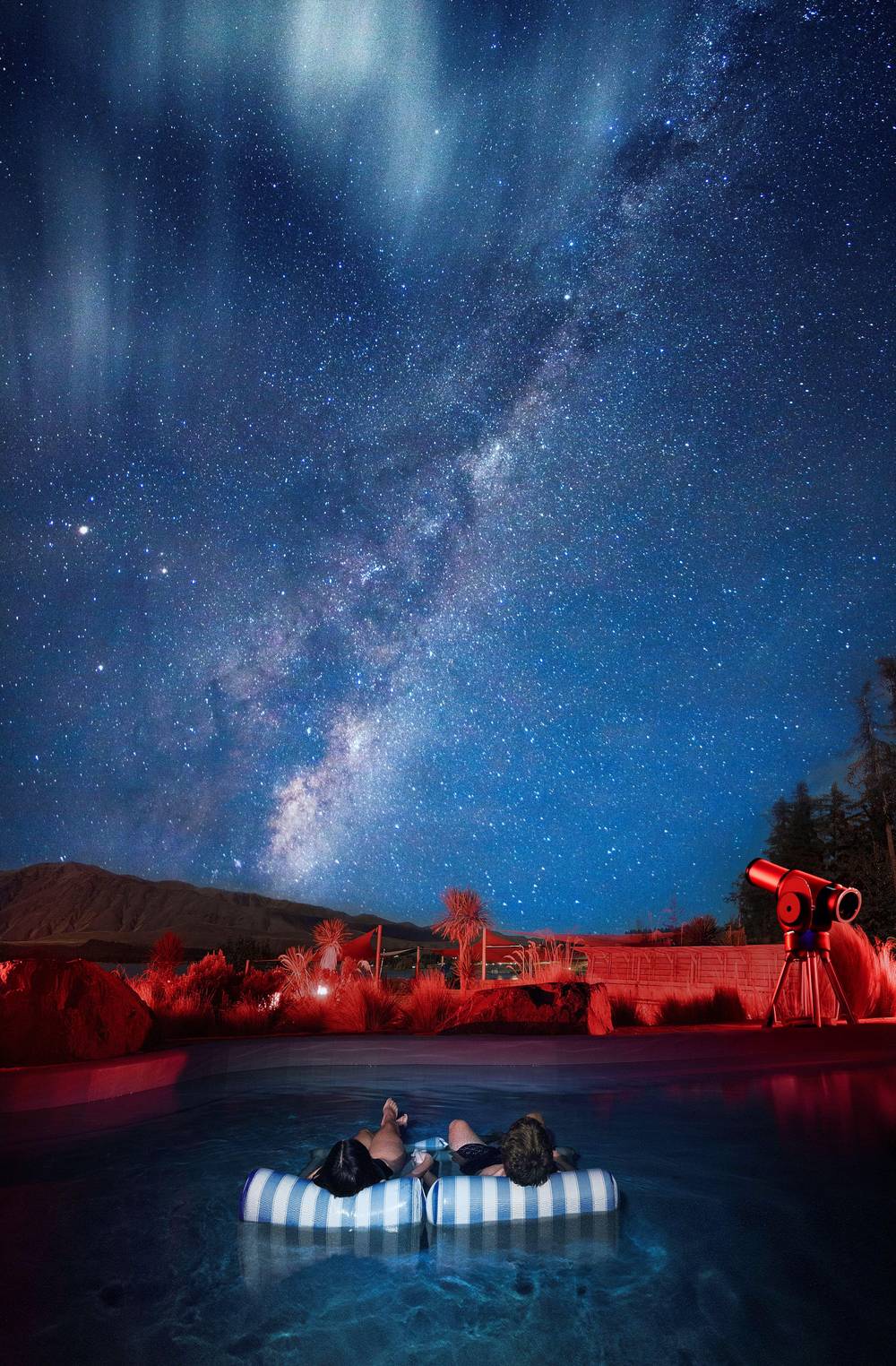
View - Pools and starsHot water first · price per person from $111
≈
View
Figures are GetYourGuide from-prices, translated at the ECB reference rate. The booking step shows what you pay exactly.
The farm tour, in order
From the office to the group photo
Check-in
The operator's office
The meeting point is the operator's office inside the Kiwi Treasure building, the Tekapo post office.
5 minutes
Safety briefing
The tour starts with a short safety briefing before anyone leaves town.
5 minutes
Transfer to the farm
A short transfer takes the group to the dark ground on the private farm.
1 hour
Guided stargazing
About an hour of guided stargazing, with 14-inch telescopes and a group of up to 10.
5 minutes
Transfer back
The group is driven back to the office after the guided hour.
48 hours
Group photo arrives
The photo taken under the stars, weather permitting, arrives by email within 48 hours.
How much dark there is, month by month
Darkness changes with the seasons more than most visitors expect. At mid-December the sun is above the horizon for 15.4 hours, which leaves only 8.6 hours without sun, while at mid-June the sun is up for 8.9 hours and the sun-free stretch is 15.1 hours.10,10 The chart on this page shows the same swing for the months between.
The swing has a practical meaning. In midsummer the sky does not get properly dark until late at night, so a tour starts late and runs close to bedtime. In midwinter it is dark early in the evening, which is kind to families and makes it easy to pair a stargazing night with an ordinary dinner. Twilight adds some extra glow at either end of those sun-free hours.
Cold travels with the dark. The average daily low in July is -3.3 °C, and the average high is 7 °C, as measured at the Tara Hills station about 73 km from Tekapo.10 In January the average low is 9.4 °C, which feels like a different place.10 Pack for the season you are visiting, and add a layer on top of whatever you think is enough.
Video
Finding the world's brightest stars in New Zealand's dark sky reserve
Tay and Trey on YouTube · Your tap on play is what loads the video.
It is exacerbated by excessive, misdirected or obtrusive use of light and is a major side effect of urbanisation.
For a clear night
What to arrange and bring
Arrange ahead4
- A spare evening in case of cloud
- Arrive for the operator's check-in time
- Check the infant limit on your listing
- Reserve now and pay later, with free cancellation
Bring along3
- A warm layer; July lows are -3.3 °C on average10
- Time to let your eyes adjust to the dark
- Flat shoes for dark farm ground
When the sky says no
Clouds can win on any night, and a guided tour does not control the weather. The summit and crater tours say so on their listings and offer an indoor alternative or a reschedule. Build a spare evening into the plan so one cloudy night does not end the trip.
There is a fallback that works in any weather. The Indoor Dark Sky Cultural Astronomy Experience lasts 45 minutes, runs in all weather and covers Maori astronomy and science with visual displays, and no outdoor stargazing is part of it. It starts from $35 and is rated 4.6 from 50 reviews.
Think of it as insurance and as background reading at once. People who see it on the first evening often go into the clear-sky night better prepared, because they already know the names. If the weather turns bad, you have lost an evening, not a trip.
FAQ
Fast, clear answers, short.
How big is the Aoraki Mackenzie dark sky reserve?
Its own site calls it the largest reserve in the Southern Hemisphere.1
What is inside the dark sky reserve?
It is comprised of Aoraki/Mt Cook National Park and the Mackenzie Basin.2
Is Lake Tekapo inside the reserve?
Do you need a tour to enjoy the dark sky?
You can look up for free, but the best dark sites need a guide and equipment; this site's farm tour is capped at 10 people.
What does dark sky friendly certification mean?
Businesses and private homes inside the reserve are invited to apply for it.8
How long are the nights in winter?
At mid-June the sun is above the horizon for 8.9 hours.10
What if the sky is cloudy?
A 45-minute indoor astronomy experience runs in all weather.
Where do tours go inside the reserve?
This site's tour uses a private 50,000-acre farm; others use a crater site and Mount John.
Sources
- Aoraki Mackenzie International Dark Sky Reserve · About the reserve ↩
- Aoraki Mackenzie International Dark Sky Reserve · About the reserve ↩
- Department of Conservation · Lake Tekapo area ↩
- Department of Conservation · Lake Tekapo area ↩
- Mackenzie Tourism · Lake Tekapo ↩
- Aoraki Mackenzie International Dark Sky Reserve · About the reserve ↩
- Aoraki Mackenzie International Dark Sky Reserve · About the reserve ↩
- Aoraki Mackenzie International Dark Sky Reserve · About the reserve ↩
- Aoraki Mackenzie International Dark Sky Reserve (official site) · Dark Sky Friendly certification ↩
- NOAA · Global Summary of the Month, Station Tara Hills, temperatures only (GHCN NZ000937470), 1991 to 2020 ↩
- Mackenzie Region New Zealand (regional tourism organisation) · Stargazing and Astrophotography ↩
- Church of the Good Shepherd · Photography ↩
- Mackenzie Tourism · Astro Café ↩
- Dark Sky Project · Stargazing tours in Tekapo ↩
Up next